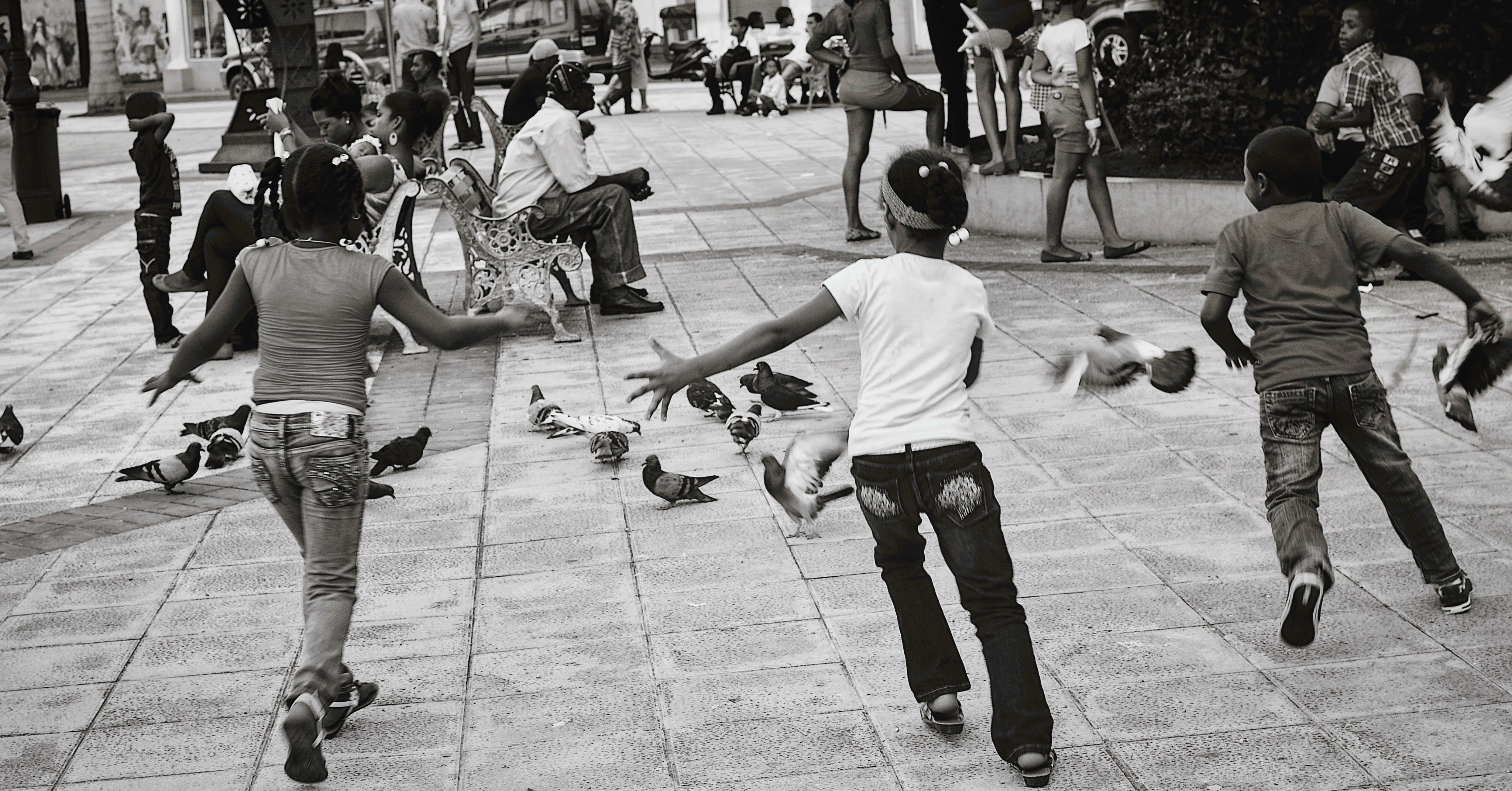
 image credit: Juan Colombo at Unsplash
In 1903, W. E. B. Du Bois famously declared that the central issue of the twentieth century would be the question of the color line. While on the surface, du Bois was referring to the figurative place of race in the collective imagination, his statement about the color line also suggested the literal spatialization of race. Racial differentiation—and its various expressions through culture, legislation, and social mores—has been historically enacted and regulated through physical lines drawn in space. In many ways, the history of racial discrimination and anti-Black sentiments in the United States can be reduced to the prohibitions—both implicit and explicit—of Black bodies in public spaces. The rallying cry that “Black Lives Matter” has made clear, now more than ever, that Black Spaces Matter too as we see the ways that social differences (perceived or real) are instituted through spatial differences.
When African-Americans were restricted from common public places and institutions earlier in this country’s history, the private homes of Black Americans and the institutions created by Black Americans became places of freedom, sanctuary, and resistance. These Black publics mattered intensely for African-Americans from the moment the first enslaved Africans were brought to this continent.
Yet notions of “Black space” had long been antithetical to academic understandings of home, public space, and common institutions. Spatial studies of the Americas in architecture and urban planning have historically taken whiteness as a default backdrop to understanding cities, landscapes, and architectures, often only turning to non-white populations to problematize the various crises afflicting cities. In recent years, that notion has changed and we increasingly have more scholarship tracing not only the place of African-Americans and other members of the Black diaspora in shaping collective spatial practices but also new studies on race and space have critiqued the histories and practices of architecture, landscape architecture, urban planning, and urban design that have sought to exclude rather than include and stratify rather than diversify.
The following books and articles reflect the most recent literature in this vein, examining the intersection of race and space, all published since January 2019. The resources cover events, reading lists, syllabi, and others. This list will be continuously updated as new publications and resources are made available. The full list is below; see abstracts and links to full text at theCommons.
Updated 12 July 2020.
Articles
- Joe Darden, Ron Malega, and Rebecca Stallings, "Social and Economic Consequences of Black Residential Segregation by Neighbourhood Socioeconoimc Characteristics: The Case of Metropolitan Detroit," Urban Studies vol. 56 no. 1 (January 2019): 115-130.
- Virginia P. Dawson, "Protection from Undesirable Neighbors: The Use of Deed Restrictions in Shaker Heights, OH," Journal of Planning History vol. 18 no. 2 (May 2019): 116-136.
- Gardiner Hallock, "Mulberry Row: Telling the Story of Slavery at Monticello," SiteLINES: A Journal of Place vol 14. no. 2 (Spring 2019): 3-8.
- Chuo Li, "Postwar Urban Redevelopment and the Politics of Exclusion: The Case of San Francisco's Chinatown," Journal of Planning History vol. 18 no. 1 (February 2019): 27-43.
- Andrea Roberts and Mohammed Javad Biazar, "Black Placemaking in Texas: Sonic and Social Histories of Newton and Jasper County Freedom Colonies," Current Research in Digital History vol. 2 (2019).
- June Manning Thomas, "Socially Responsible Practice: The Battle to Reshape the American Institute of Planners," Journal of Planning History vol. 18 no. 4 (November 2019): 258-281.
Books
- Frederick M. Binder, David M. Reimers, and Robert W. Snyder, All the Nations under Heaven: Immigrants, Migrants, and the Making of New York, Revised Edition (Columbia University Press, 2019).
- Lawrence T. Brown, The Black Butterfly: The Harmful Politics of Race and Space in America (Johns Hopkins University Press, 2021).
- Karen Chapple and Anastasia Loukaitou-Sideris, Transit-Oriented Displacement or Community Dividends? Understanding the Effects of Smarter Growth on Communities (MIT Press, 2019).
- Irene Cheng, Charles L. Davis II, and Mabel O. Wilson, Race and Modern Architecture: A Critical History from the Enlightenment to the Present (University of Pittsburgh Press, 2020).
- Orly Clerge, The New Noir: Race, Identity, and Diaspora in Black Suburbia (University of California Press, 2019).
- Martha J. Cutter, The Illustrated Slave: Empathy, Graphic Narrative, and the Visual Culture of the Transatlantic Abolition Movement, 1800-1852 (University of Georgia Press, 2020).
- Charles L. Davis II, Building Character: The Racial Politics of Modern Architectural Style (University of Pittsburgh Press, 2019).
- Hubert Fichte, The Black City (MIT Press, 2019).
- Laura Forlano, Molly Wright Steenson, and Mike Ananny, Bauhaus Futures (MIT Press, 2019).
- Marco Garrido, The Patchwork City: Class, Space, and Politics in Metro Manila (University of Chicago Press, 2019).
- Bruce D. Haynes and Syma Solovitch, Down the Up Staircase: Three Generations of Harlem Family (Columbia University Press, 2019).
- Anne Harley and Eurig Scandrett, Environmental Justice, Popular Struggle and Community Development (Bristol University press, 2019).
- Claire W. Herbert, A Detroit Story: Urban Decline and the Rise of Property Informality (University of California Press, 2020).
- Walter Hood and Grace Mitchell Tada, Black Landscapes Matter (University of Virginia Press, 2020).
- Mark Jay and Philip Conklin, A People's History of Detroit (Duke University Press, 2020).
- Lorraine Leu, Defiant Geographies: Race and Urban Space in 1920s Rio de Janeiro (University of Pittsburgh Press, 2020).
- Johana Londoño, Abstract Barrios: The Crises of Latinx Visibility in Cities (Duke University Press, 2020).
- Marcus P. Nevius, Slavery and Petit Marronage in the Great Dismal Swamp, 1763-1856 (University of Georgia Press, 2020).
- Ana Y. Ramos-Zayas, Parenting Empires: Class, Whiteness, and the Moral Economy of Privilege in Latin America (Duke University Press, 2020).
- Monique Roelofs, Arts of Address: Being Alive to Language and the World (Central European University Press, 2020).
- Ashanté M. Reese, Black Food Geographies: Race, Self-Reliance, and Food Access in Washington, D.C. (University of North Carolina Press, 2019).
- Carlo Rotella, The World Is Always Coming to an End: Pullng Together and Apart in a Chicago Neighborhood (University of Chicago Press, 2019).
- Timo Schrader, Loisaida as Urban Laboratory: Puerto Rican Community Activism in New York (University of Georgia Press, 2020).
- Keeanga-Yamahtta Taylor, Race for Profit: How Banks and the Real Estate Industry Undermined Black Homeownership (University of North Carolina Press, 2019).
- Bobby M. Wilson, America's Johannesburg: Industrialization and Racial Transformation in Birmingham (University of Georgia Press, 2019).
Resources
The above lists include only books and journal articles published within the last two years (since January 2019). The resources below include reading lists of older texts, articles from online magazines and news sources, podcasts, videos, calls for papers and proposals, syllabi, and other resources on race and space.
- Native Voices with the Harvard Indigenous Design Collective.
- 5 Essential Books to Read on Making Cities Anti-Racist by Diana Budds.
- How Residential Segregation Looked in the South by Matthew Wills.
- The Planner's Beginner Guide to the #BlackLivesMatter Movement by Danielle Dirksen.
- Social Value in Architecture, a special issue of Architectural Design.
- Teaching Equity and Advocacy Planning in a Multicultural "Post-racial" World by Willow Lung-Amam, Stacy Anne Harwood, Gerardo Francisco Sandoval, and Siddhartha Sen.
- Resisting in Place.
- Design as Protest, a collective of anti-racist designers dedicated to Design Justice.
- Police Brutality at the U.S. 'Black Lives Matter' Protests, a map by Forensic Architecture.
- Black People, Porches, and Politicsby Germane Barnes.
- The Architects of Systemic Racismby Wandile Mthiyane.
- Changing the Subject: Race and Public Space, a conversation between Julian Rose and Mabel O. Wilson.
- Signs of Environmental Discrimination by Byron Nicholas.
- Space/Race Reading List
- Race, Space, and Architecture
- Geographies of Racial Capitalistm with Ruth Wilson Gilmore.
- Urban Spaces and the Mattering of Black Lives by Darnell L. Moore.
- Racism and Cities with Mabel O. Wilson, Akira Drake Rodriguez, and Bryan Lee.
- Blackout — Amplifying the Voices of Blackness Within Architecture by Sekou Cooke.
- Call for Papers—Land Back: Indigenous Landscapes of Resurgence and Freedom 2021 Garden and Landscape Studies Symposium at Dumbarton Oaks.
- The Black Skyscraper: Architecture and the Perception of Race, by Adrienne Brown.
- When Ivory Towers Were Black: A Story about Race in America's Cities and Universities, by Sharon Egretta Sutton. Chronicles the effects of the Black Power Movement on Columbia University's School of Architecture.
- Stop Wasting Our Time by Mitch McEwen.
- Bryan C. Lee on Design Justice and Architecture's Role in Systemic Racism.
- Darien Williams: Chronicling Black resilience to disaster.
- 2020 Writers Fund, a fund supporting the work of BIPOC authors in public scholarship on architecture, landscape, and urbanism.
- A reading list of Black geographers.
- Green Space, White Space: Racial Equity and Public Places, a webinar with Kenneth Baily, Stephen Gray, Karen Mauney-Brodek, and F. Philip Barash.
- Continuum on Becoming an Anti-Racist Multicultural Organization
- The Digital Now: Architecture and Intersectionality, a call for proposals for multi-disciplinary projects on the intersection of digital design with race, class, gender, ability, and sexuality.
- Institutionalized Racism: A Syllabus
- Call for Lectures: Anti-Racism and Global Architectural History
- Urban Spaces and the Mattering of Black Lives, by Darnell Moore
- Defining the Just City beyond Black and White, by Toni L. Griffin
- Putting Freedom Colonies on the Map, an article by Tatiana Walk-Morris about Andrea Roberts'project to document and preserve Black settleements in Texas.
- Whose Streets? Black Streets, four actions for planners and urbanists to take to tackle racism, by Amina Yasin.
- Breathing While Black: Fighting Environmental Racism in the South, a film screening and Q&A panel discussion moderated by Danielle Purifoy.
- The Fight to Preserve African-American History, by Casey Cep.
- Nine ideas for making our city’s public space more race equitable, by Carolina A. Miranda.
- When Minneapolis Segregated, by Greg Miller.
- Reading for Racial Justice, a collection of anti-racist books made available by University of Minnesota Press to read free online through August 31, 2020.
- Tulsa Syllabus: The Rise, Destruction, and Rebuilding of Tulsa's Greenwood District, a source list curated by Alicia Odewale and Karla Slocum.
- Hip Hop Architecture Camp, a virtual camp for school-age youth by Michael Ford.
- Race, Architecture, Social Equity, a resource list by Daniel Barber.
- 'Race' and Space': A new curriculum for the built environment
- Bookmark These Professional Resources for Black Designers and Architects
- New Architecture Writers, a free program for young BAME design critics.
- What Kind of Society Values Property Over Black Lives?, by Robin D. G. Kelley
- The Black Man and His Architecture, a 1970 review by architectural critic Ada Louise Huxtable of an AIA exhibition of the same name.
- A Call to Explore: Design, Race, and the Built Environment by Harvard Graduate School of Design
- BlackSpace
- The Black Urbanist.
- A Call to Courage: An Open Letter to Canadian Urbanistsby Jay Pitter.
- How to End Anti-Blackness in Cities: Black designers and planners are mobilizing their industries to eradicate racism in urbanism, by Alissa Walker at Curbed.com.
- Land loss has plagued black America since emancipation - is it time to look again at 'black commons' and collective ownership? by Julian Agyeman.
- Segregation and Resistance in America's Urban Landscapes, virtual symposium hosted by Dumbarton Oaks.
- The Right to Infrastructure, an project by Danielle Purifoy and Louise Seamster to "identify and examine a pattern of racialized extractive practices and predatory governance in black towns."
- In Conditons of Fresh Water, an "art and oral history project that will chronicle the histories, power struggles and victories of historic Black places," by Danielle Purifoy and Torkwase Dyson.
- Black Towns and the Freedom to Breathe by Karla Slocum.
- Black Lives: In the Era of COVID-19 podcast.
- Equality in Transportation Planning, CoMotion podcast with Destiny Thomas on why open streets aren't necessarily equal streets.
- Black Perspectives' Black Ecologies series on Black communities and environmental change.
- Unequal Impact: The Deep Links between Racism and Climate Change, an interview with environmental justice activist Elizabeth Yeampierre.